
Last Updated: November 2, 2026
Quick Summary
To measure ceiling fan blades, stretch a tape measure from one blade tip straight across the fan's center to the opposite blade tip and read the number in inches. For fans with an odd blade count, measure from one blade tip to the hub center and multiply by two. That single figure is your blade span.
- Blade length is the hub-to-tip radius; double it to get the span.
- A tip-to-center reading of 24 inches means a 48-inch span.
- Standard five-blade fans usually land in the 42 to 52 inch range.
- Turn off the fan at the switch and breaker before measuring.
- Fan Blade Designs covers fit standard five-blade fans with 19 to 22 inch blades.
Table of Contents
- What Is Blade Span of a Ceiling Fan?
- How to Measure Ceiling Fan Blades in Inches
- How to Measure a 3 Blade Ceiling Fan
- Using a Ceiling Fan Size Calculator for Your Room
- Safety, Accuracy, and Common Measurement Mistakes
- Check Your Fan's Fit Before You Buy Blade Covers
- Frequently Asked Questions
What Is Blade Span of a Ceiling Fan?
Blade span is the full width of a ceiling fan measured from the tip of one blade straight across to the tip of the opposite blade.
Here's the part most guides skip: the number you need depends on why you're measuring. Buying a replacement fan? You need the full span.
Blade span, sometimes called fan diameter, is the tip-to-tip distance across the fan's full sweep.
U.S. Department of Energy guide to ceiling fans notes that fan size should match room size for efficient air circulation, so an accurate span measurement matters beyond shopping.
Blade Span vs. Blade Length: What's the Difference
Blade length is the distance from the fan's center hub to the tip of a single blade. That is the radius, not the span. Double it and you get the span.
A fan with a 26-inch blade length has a 52-inch span. Retail listings almost always quote span, so measuring blade length and calling it span will point you at the wrong size.
How to Measure Ceiling Fan Blades in Inches
To measure ceiling fan blades in inches, stretch a tape measure from one blade tip across the fan's center to the opposite blade tip. Read the number in inches.
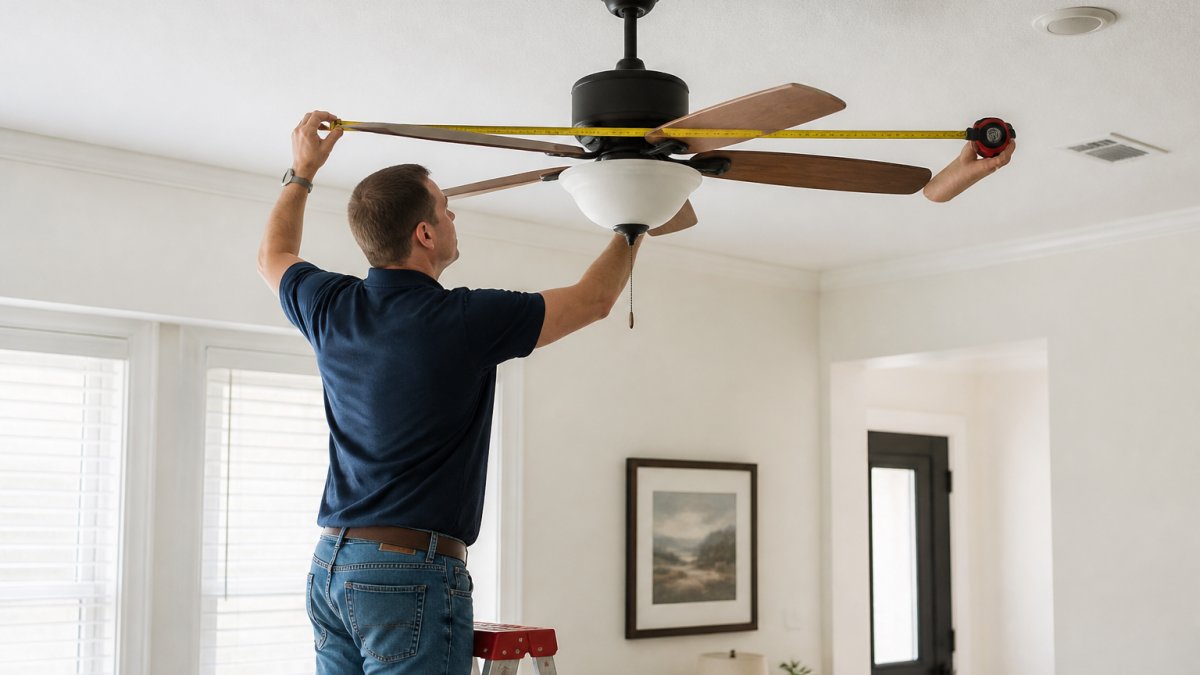
Turn the fan off and let the blades stop completely before you start. Then follow the method that matches your blade count.
Even Blade Count: Measure Tip to Tip
Fans with four or five blades are the easiest. Pick any blade, find the blade directly across from it, and run the tape from tip through the center hub to the opposite tip. Standard five-blade fans usually land in the 42 to 52 inch range.
Odd Blade Count: Measure Tip to Center
Three-blade and five-blade fans with no direct opposite blade need a different approach. Measure from one blade tip to the exact center of the hub. Multiply that number by two. The result is your span.
A tip-to-center reading of 24 inches means a 48-inch span. This method works for any odd blade count.
How to Measure a 3 Blade Ceiling Fan
Measuring a 3 blade ceiling fan means measuring from a blade tip to the hub center, then doubling it. There's no opposite blade to measure across, so the tip-to-center method is your only accurate option.
Here's the full procedure:
- Turn off the fan at the switch and the breaker, and confirm the blades have stopped.
- Find the exact center of the hub, not the edge of the motor housing.
- Hook the tape at one blade tip.
- Extend it straight to the hub center and note the inches.
- Multiply by two.
A tip-to-center reading of 24 inches means a 48-inch span. Repeating the measurement on a second blade and averaging the two catches a bent or sagging blade before it skews the result.
Watch out: measuring to the outer edge of the motor housing instead of the hub center inflates your span. A fan that measures 50 inches this way may really be a 44-inch model.
Measuring when a blade is missing, damaged, or uneven
If one blade is broken or removed, don't measure across the gap. Measure an intact blade from tip to hub center and double it, as long as the remaining blade is straight and correctly angled.
Uneven blades give inconsistent tip-to-center readings. Compare two or three intact blades; if readings differ by more than about a quarter inch, the fan needs repair or replacement before you size covers or replacement blades.
Blade span vs. single-blade length for replacement shopping
Replacement blade listings usually quote the length of one blade, not the full span. Measure one intact blade from the hub mounting point to the tip, and record the span separately. A fan with a 52-inch span typically uses blades in the 24 to 26 inch range, but match the listing to your measured blade length rather than the span alone.
A worked example
Suppose you measure from a blade tip to the hub center and get 21 inches. Double it for a 42-inch span, and confirm on a second blade. Then measure that blade from leading edge to trailing edge, say 5 inches, and record the blade width. You now have the two numbers a cover or replacement-blade listing needs.
Using a Ceiling Fan Size Calculator for Your Room
A ceiling fan size calculator matches span to room square footage. Measure your room's length and width in feet, multiply them for square footage, then compare against standard sizing guidance.
ENERGY STAR guidance on ceiling fan sizing recommends matching fan diameter to room dimensions so the fan moves air across the whole space. As a general rule:
| Room Size | Suggested Fan Span |
|---|---|
| Up to 75 sq ft | 29-36 inches |
| 76-144 sq ft | 36-42 inches |
| 144-225 sq ft | 44-50 inches |
| 225-400 sq ft | 50-54 inches |
| Over 400 sq ft | Multiple fans |
Ceiling height matters too. Low ceilings need a fan mounted close to the ceiling, and very high ceilings may call for a downrod. Measure both before you shop.
Safety, Accuracy, and Common Measurement Mistakes
Accuracy comes down to a repeatable procedure, not a single careful reading. Most errors trace back to four habits: reading to the wrong reference point, measuring on a diagonal, mixing up radius and diameter, or recording a number without confirming it.
Measure an installed fan safely
You can measure a ceiling fan without removing it, but only after it is fully de-energized. Turn the fan off at the wall switch, then turn off the circuit breaker feeding the ceiling box.
Use a sturdy step stool or ladder rated for your weight, set on a level floor and clear of the fan's sweep. Have a second person steady the ladder and hand you the tape.
Locate the true hub center
The hub center is the point at the center of the motor housing where the blades attach, not the outer rim and not the bottom of the light kit. On most fans it's marked by a screw, a cap, or the center of the downrod above it. If no center point is visible, hold a straightedge across the housing and mark the midpoint, or drop a plumb line from the ceiling box.
Keep the tape straight and level
Run the tape straight across the fan's centerline, parallel to the floor, with no sag and no diagonal; an angled tape reads longer than the true span. For an even-blade fan, hook one blade tip and read at the opposite tip. For an odd-blade fan, read from tip to hub center and double it.
Record span and width separately
Write down the span in inches and, if shopping for covers, the blade width across a single blade from leading edge to trailing edge. Label each number so you don't mistake blade length for span. Re-measure once to confirm.
Common mistakes to avoid
- Measuring blade length and reporting it as span
- Reading to the motor housing edge instead of the hub center
- Measuring on a diagonal instead of straight across the centerline
Blade width is the measurement across a single blade from leading edge to trailing edge. Covers need both span and width to fit properly.
Concerned about upkeep once covers are on? Fan Sox are machine washable.
Check Your Fan's Fit Before You Buy Blade Covers
Once you have your span and blade width, you can check whether covers fit your fan. Fan Blade Designs covers are designed for standard five-blade fans with 19 to 22 inch blades.
Not sure your fan qualifies? Our ceiling fan blade cover sizing guide walks through the fit check step by step. Then read how to install fan blade covers so the covers go on straight and stay put. If you're still deciding between updating your current fan and replacing it, see our comparison of replacing a ceiling fan versus decorating it. And when you're ready to browse, our decorative ceiling fan blade covers come in dozens of designs.
Fan Sox slip over your existing ceiling fan blades. They're machine washable, need no painting or permanent changes, and suit renters and homeowners alike.
Frequently Asked Questions
How do you determine ceiling fan blade size?
Measure from one blade tip straight across to the opposite blade tip for fans with an even number of blades, then round to the nearest standard size. For fans with an odd number of blades, measure from one blade tip to the center of the fan and multiply by two. The result is the blade span, which is the number manufacturers use to label fan size.
Does the number of blades change how you measure a ceiling fan?
Yes, it changes the method but not the goal. Even-blade fans let you measure tip to tip because opposite blades line up. Odd-blade fans have no opposite blade, so you measure from a blade tip to the fan center and double it. Both methods give you the blade span, so a 3 blade ceiling fan and a 5 blade fan of the same span measure the same overall size.
How do you measure ceiling fan blades for covers?
Measure one blade from the tip to where it meets the hub, since covers slide over individual blades rather than the whole span. Check your blade length against the cover's stated range before ordering. Fan Blade Designs covers fit standard blades measuring 19 to 22 inches. If your blades fall outside that range, confirm fit with the seller before buying.
What size fan do I need for my room?
Match blade span to square footage. Rooms up to 75 square feet typically take a 29 to 36 inch fan, rooms around 144 square feet take 42 to 48 inches, and rooms of 225 square feet or more take 50 to 54 inches. Rooms over 400 square feet may need more than one fan. Measure your room's length and width and multiply them to get square footage first.
Measuring your ceiling fan blades shouldn't be the hard part of refreshing a room. Fan Blade Designs makes the next step simple with removable, machine-washable slipcovers that fit standard 19 to 22 inch blades and come in 70 designs. Get started with Fan Blade Designs and update your ceiling fan's look in minutes, no tools or permanent changes required.


