
Quick Summary
Measure your fan's blade span, single-blade length and width, and floor clearance with the power off before buying. Fan blade covers fit standard five-blade fans with blades between 19 and 22 inches, and on a low ceiling, choose a thin, snug cover that ends at or before the blade tip.
- Measure blade span tip to tip, not the length of one blade.
- Fan Blade Designs covers fit standard blades between 19 and 22 inches.
- Aim for at least seven feet between blade tips and the floor.
- Measure with the fan switched off, since spinning blades can skew readings by an inch or more.
- Check that each cover ends at or before the blade tip to protect clearance.
Table of Contents
- Why Low Ceilings Make Blade Covers Tricky
- How to Measure Ceiling Fan Blades and Floor Clearance
- What Type of Fan Is Best for a Low Ceiling
- Using a Ceiling Fan Size Calculator to Match Blade Covers
- Ceiling Fan Blade Covers and Airflow: What to Check Before You Buy
- Frequently Asked Questions
Why Low Ceilings Make Blade Covers Tricky
Removable poly-spandex fan blade covers slip over standard five-blade ceiling fans, and low ceilings are where many buying mistakes happen. A fan that clears the floor fine in a standard room can sit too close to a shorter person's head, and a cover that adds thickness can make that problem worse.
The fix starts with measuring before you shop, not after the covers arrive.
Covers add a small amount of bulk to each blade. That bulk matters little on a tall ceiling. On a low one, it can push blade tips closer to the floor or turn a comfortable fan into a hazard. Choosing well means checking three things: the fan's current clearance, the cover's fit on your blade size, and how the fan will move air once dressed.
Keep these points in mind:
- Low ceilings leave less room for error.
- Covers change the blade profile, even slightly.
- Your fan's size, mount, and airflow all affect the choice.
How to Measure Ceiling Fan Blades and Floor Clearance
Start by measuring your existing fan with the power off and the blades still. You need more than the blade span to choose covers that fit and stay safe on a low ceiling. Build a short measurement sheet before you shop.
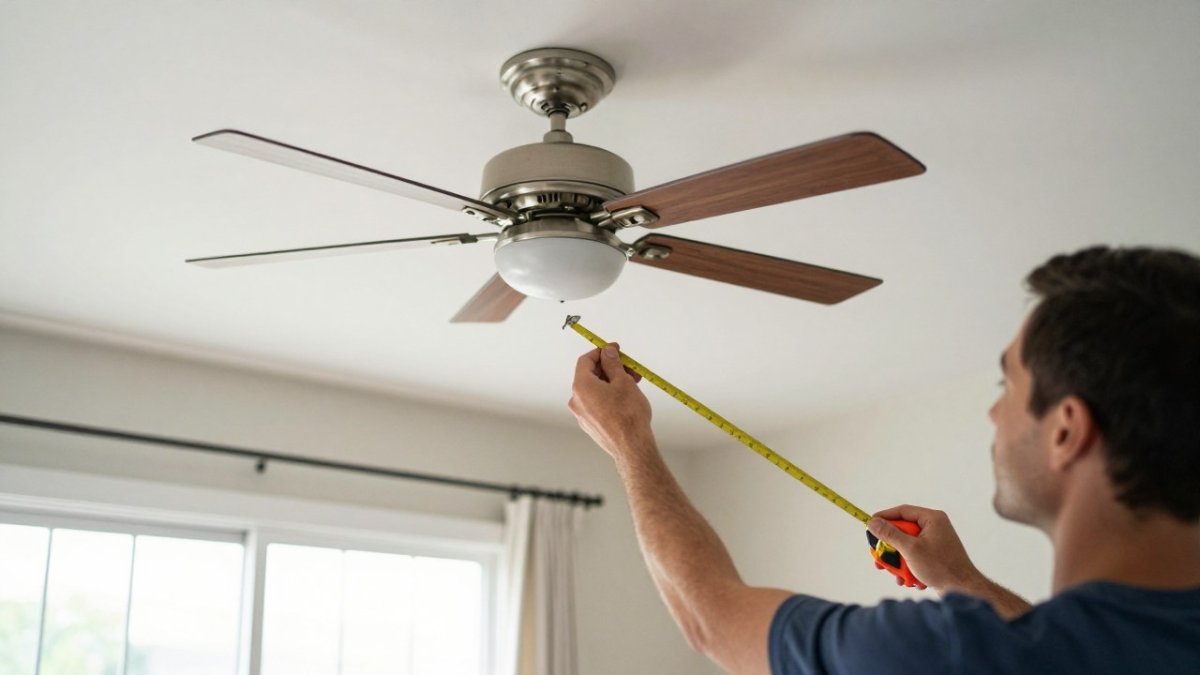
Blade span. Measure from tip to tip across the full diameter of the fan, not the length of one blade. Fan Blade Designs covers are designed for standard blades between 19 and 22 inches, so this number is your first fit check.
Individual blade length and width. Span tells you the overall diameter; it does not tell you whether a cover will fit one blade.
Blade thickness and attachment points. Covers slip over the blade, so the blade's thickness at the root and the shape of the blade irons (the metal arms that hold the blade) affect fit.
Floor clearance. Standing on a stable step stool, measure from the lowest point of the blades to the floor with the fan off. Write down the number. Common ceiling fan guidance calls for at least seven feet between the blade tips and the floor.
Ceiling height and installed height. Note the room's ceiling height in feet, and note the fan's installed height, how far the blades hang below the ceiling. A flush-mount or low-profile fan has a smaller installed height, which raises the blades and leaves more room below.
Number of blades. Fan Blade Designs covers are designed for five-blade fans. Count your blades; a four- or six-blade fan may need a different cover set.
What to write down:
- Blade span in inches
- Single-blade length and width in inches
- Blade thickness at the root and any attachment hardware to clear
- Floor clearance in inches
- Ceiling height in feet
- Installed height in inches
- Number of blades
A common mistake is measuring with the fan on. Blades wobble when spinning, so the reading can be off by an inch or more. Always measure with the fan switched off and the blades still.
Checking Minimum Blade Clearance
Compare your floor clearance with the seven-foot guideline. If the fan already sits close to the limit, skip covers and consider a different fan instead. If you have room to spare, a thin cover usually adds only a small amount of bulk.
After the covers are on, measure again. Slip one cover over a blade, then measure from the lowest point of the covered blade to the floor with the fan off. If the covered blade drops below your comfort threshold, remove the covers and reassess. On a low ceiling, the difference between a bare blade and a covered blade can be the difference between comfortable headroom and a hazard.
Watch out: a cover that hangs past the blade tip adds length as well as thickness, and that extra length is what most often reduces clearance on a low ceiling. Check that each cover ends at or before the blade tip, not beyond it.
What Type of Fan Is Best for a Low Ceiling
For a low ceiling, a flush-mount fan is usually the best choice. It mounts close to the ceiling, so the blades sit higher than they would on a standard downrod.
Here is how the main options compare:
| Fan Type | Installed Height | Best For |
|---|---|---|
| Flush-mount | Very close to ceiling | Low ceilings, small rooms |
| Hugger mount | Close to ceiling | Moderate-low ceilings |
| Standard with downrod | Hangs below ceiling | Tall ceilings only |
A downrod drops the fan lower, so skip it on a low ceiling. A short downrod can work in some rooms, but the blades still come closer to the floor than you may want.
Fan size matters too. A fan that is too large for the room can feel crowded and move more air than the space needs. Pick a blade span that suits the room's square footage, then confirm that the covers match the blade size.
Using a Ceiling Fan Size Calculator to Match Blade Covers
A ceiling fan size calculator helps you pick a blade span for your room. Enter the room's length and width, and the tool suggests a fan diameter. Use the result to check whether your current fan is the right size before you buy covers.
Many calculators work from square footage. A small room needs a smaller fan, and a larger room needs a wider span. Fan Blade Designs covers fit blades between 19 and 22 inches, so if your calculator recommends a fan outside that range, the covers may not fit.
Follow these steps:
- Measure the room's length and width in feet.
- Multiply them to get square footage.
- Enter the square footage into the calculator.
- Compare the suggested span with your fan's blade span.
If the numbers match, the covers are a reasonable choice. If they don't, the fan is likely the wrong size for the room, and covers won't solve that.
Ceiling Fan Blade Covers and Airflow: What to Check Before You Buy
Covers are slipcovers, so they sit over the blade surface and change the blade's profile. To see how covers can affect airflow and what to check, read Do Sleeves Affect Airflow. For details on the material covers are typically made from, see the Poly Spandex Fan Cover Guide.
How covers change airflow. A ceiling fan moves air by pushing it downward along the blade's pitch. A thin, close-fitting cover that follows the blade's contour changes that flow only slightly.
How to assess the trade-off before buying. Do not assume a cover is aerodynamically neutral. Use the fan's published CFM (cubic feet per minute) rating as your baseline, then judge the cover by fit: a cover that lies flat against the blade and does not billow is the least likely to change performance.
Noise. A cover that flaps, rubs, or sits unevenly can produce a soft rhythmic sound, especially at higher speeds. Snug covers that follow the blade shape are quieter. Run the fan on low first, then medium, and listen for new sounds before committing to a full set.
Motor load and balance. Light fabric covers add little weight, but weight is not the only concern. If one cover sits differently from the others, bunched at the tip, twisted at the root, the fan can wobble. Wobble stresses the motor mount and can loosen fasteners over time.
Dust control versus airflow. Covers catch dust that would otherwise settle on bare blades, and they are machine washable. To compare this with cleaning bare blades, see Washable Covers Versus Dusting Fans. That is a real maintenance benefit.
Watch out: a cover marketed as "universal" may fit loosely on your blade width, and a loose cover is the one most likely to reduce airflow and add noise. Check the cover's stated blade-length and blade-width range against your actual measurements before ordering.
Frequently Asked Questions
What type of fan is best for a low ceiling height?
For a low ceiling, a flush-mount or hugger-style fan is usually the best choice because it sits close to the ceiling and keeps the blades higher above the floor. Look for a model with a short downrod or none at all. Check minimum blade clearance, which is commonly around 7 feet for standard fans. A low-profile fan with a compact motor housing gives you more headroom while still moving air effectively in the room.
Can ceiling fan blade covers affect airflow or fan balance?
Yes, they can. Any added material on a blade changes its weight, surface area and how air moves over it, which can affect airflow, noise and motor load. Covers that are heavy, loose or uneven may throw the fan out of balance and cause wobble. Choose lightweight covers that fit snugly, and check that they do not interfere with the fan's rated operation. If the fan starts to wobble after installing covers, remove them and rebalance the blades.
How do you measure ceiling fan blades for covers?
Measure the blade length from the center of the motor housing to the tip of each blade, and note the blade width at its widest point. Many covers are sized for standard blade spans, so compare these numbers with the sizing chart. Also measure the distance from the blade's leading edge to the mounting screws. Writing down all measurements before you shop helps you avoid buying covers that are too short or too narrow.
Do fan blade covers fit every ceiling fan?
No. Covers are made for specific blade sizes, shapes and counts, so a cover sized for one fan may not fit another. Standard five-blade fans with blades in the 19 to 22 inch range are a common fit for many slipcover designs, but unusual blade sizes or shapes may not work. Before buying, measure your blades and compare them with the product's listed dimensions.


